

July 11, 2015
When you’re trying to get fit, you usually look to the people who are already fit. They must know something, right? So, you talk to them, ask them how they got where they are and…
Enter “bro science.”
Bro science is well-intentioned advice friends who work out together typically give each other that they trust and believe in. This is usually because:
a) they heard it from another person who was really fit
b) they believe it and just so happens to work for them; or
c) “It’s science, look it up.”
Well, we did look it up.
The basic problem with bro science is this: as with many believable rumors, there’s usually a kernel of truth stuck in each one. Many bro science myths begin based in good fitness science, but later, the science gets taken out of context, misinterpreted, or misunderstood.
The other problem is, in many cases, these myths have been so popular (and spread by popular media) for so long that they are simply accepted as truth. The problem is that these myths can lead to wasted time, money, and energy. They can also lead to frustration and quitting when the promised results don’t come.
To make sure you don’t fall for misguided bro science, we’ve busted 10 myths to set the record straight on what’s good science and what’s better left in the locker room.
#1 Eating at night makes you fat
The myth: “Stop eating meals late at night. If you eat right before sleeping, your body turns whatever you ate straight into fat.”
The facts: It’s not about when you eat your meals: it’s about your calorie intake and exercise level. According to the Center for Disease Control, it’s the calories you burn over a 24-hour period that determines fat gain/loss, not when you intake those calories.
A 2015 meta-analysis published in the nutrition journal Nutrients goes even further. Far from being a recipe for guaranteed fat gain, nighttime meals were shown to:
improve protein synthesis in healthy individuals who ate small, nutrient-dense meals before sleeping. They built muscle, not fat.
have no effect on weight gain among obese individuals who participated in a high intensity cardiovascular exercise program during the day
Why do people believe this myth? It’s likely because when people do eat in the evening, they tend to eat and drink things with high caloric content: processed foods, alcohol, carbohydrates, and other things that pack on the calories. An extra 500-1000 calories after 8pm is fairly easy to add if you aren’t careful.
The takeaway: It’s about the calories themselves, not about the time.
#2 Cardio on an empty stomach is the secret to burning fat
The myth: “If you want to burn pure fat, don’t eat before doing cardio. This way, you’ll burn pure fat. It’s like a fat-burning hack.”
The facts: This one actually has a basis in physiological research describing where the body gets its energy during aerobic exercise. It can come from two places – either glycogen from carbohydrates or from fat tissue. During aerobic exercise, the body will first metabolize (or burn) glycogen and then metabolize fat for energy.
So the bro scientists take this fact and make the leap: “If I don’t eat anything before cardio, I’ll have no glycogen from carbs, and my body will go straight into burning fat! Perfect!”
Although this sounds like a logical assumption, studies have shown otherwise.
In a comparison of healthy men and women who trained either with or without eating before steady state cardio, a 2010 study showed that there was no significant difference in fat or carbohydrate use between the groups who were fed and the groups who had fasted overnight. For people who perform High Intensity Interval Training (HIIT) cardio, a 2013 study found no difference in body composition between groups that fasted and groups that didn’t.
Although some people may have had success in doing cardio on an empty stomach, it’s far from being a secret recipe to maximize fat loss and may have had more to do with overall calorie reduction in the first place.
The takeaway: Don’t stress about eating/not eating before cardio. Focus on high-intensity workouts and burning calories if you want to burn fat.
#3 You can lose 1 pound of fat a week by cutting 500 calories a day
The myth: “One pound of fat is equal to 3500 calories, so if you want to burn a pound of fat a week, you need to cut your calorie intake by 500 calories a day. 500 x 7 = 3500 calories (one pound of fat.)”
The facts: While it is true that running a modest calorie reduction typically results in overall weight loss, this “500 calories a day = 1 pound a week of fat loss” is an oversimplification of how weight loss occurs. It’s based on the faulty assumption that you can lose 100% pure fat with simple calorie reduction, which is not true.
Your body and your weight are made up of several components, including muscle, fat, and water. Depending on how you are losing weight, you may not be losing just fat – you may be losing some of everything. How much of each varies for each individual based on their current body composition and their activity level.
As you lose fat mass solely by calorie restriction, you are very likely going to lose Lean Body Mass as well. How much Lean Body Mass (and Skeletal Muscle Mass) you lose has a lot to do with your current body composition. If you are overweight and have a lot of weight to lose, a greater proportion of weight loss will come directly from fat.
However, if you are already lean and start losing weight, a greater proportion of weight loss will come from Lean Body Mass. Whether or not you are engaged in a resistance training program also plays a role.
The takeaway: While it is true that you will lose fat by running a calorie deficit, don’t expect to lose 1 pound of pure fat a week like clockwork, especially if you are not exercising.
#4 To Maximize Fat Burn, Do Cardio Workouts in the “Fat Burning Zone”
The myth: “This might surprise you, but, if you want to burn fat most efficiently, it’s better to work out in your particular Fat Burning Zone. Don’t let your heart rate (BPM) get above 60% of your recommended maximum HR for your age.”
The facts: Plastered on treadmills and ellipticals in gyms everywhere is the familiar heart rate graph. They usually have a couple different colored bands that show what heart rate to work out at in order to achieve some kind of goal. They usually look something like this:
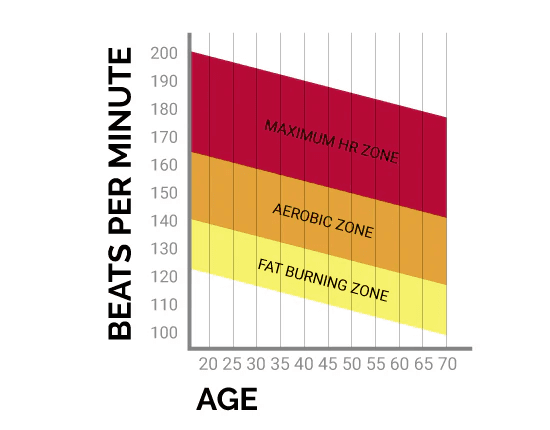
This myth is based on a misinterpretation about where the body gets energy during exercise. As mentioned in myth #9, the body has two sources of energy to choose from during exercise: glycogen and fat stores. At lower intensities, the body tends to prefer drawing energy from the fat stores.
At lower intensities, the body doesn’t burn more fat, it just burns more fat than carbohydrates during exercise. In other words, in the “fat burning zone” you burn a greater percentage of fat, but less fat overall. In terms of total fat loss, overall calorie burn, including calories from fat, will be less if you stay in the “fat burning zone” than if you exercised at high intensity.
Furthermore, higher intensity exercise, whether it be cardio or resistance training, will burn more calories after the workout is completed. In a study that compared low-intensity continuous cycling versus high-intensity interval cycling, it was found that the high-intensity group used more energy over a 24-hour period, despite the fact that both groups cycled the same total time each day (60 minutes).
The takeaway: Focus on burning as many calories as possible to lose fat.
#5 The best way to get skinny is to do tons of cardio, cut calories, and avoid lifting
The myth: “To burn fat, you gotta do cardio and cut calories. Cut your calories, especially carbs, while hitting the treadmill super hard, and you’ll shed off fat like it’s nothing. If you start lifting, you’ll get bigger and bulkier, not skinnier.”
The facts: This is probably one of the most common myths about burning fat and losing weight out there: endless, extremely long cardio sessions coupled with severe calorie restriction and a de-emphasis on weight lifting is the key to a skinny physique. Primarily targeted at women, it’s this myth that fills treadmills and spinning classes in gyms worldwide.
It’s not that modest calorie restriction and cardio won’t burn fat and lead to weight loss; it will. It’s the extremes people take with either or both of these strategies that can sabotage your goals.
Yes: aerobic exercise will burn fat and lead to weight loss. But it’s extremely difficult to burn fat and only fat. If you’re attempting to lose weight purely through cardio, you stand to lose muscle and water in addition to fat mass.
Research has shown that when cardio begins in a reduced glycogen state, which can result from caloric restriction (and compounded by excessive cardio workouts), a net degradation of protein in muscle occurs. Severely cutting calories or going on a crash diet can also lead to drops in testosterone levels, which does little to guard against muscle loss
It’s also true that cutting calories in order to run a calorie deficit will lead to weight loss. This leads some people to go to extremes in cutting calories while doing intense amounts of cardio, but this can have adverse effects. Studies have shown that weight loss strategies that focus on calorie restriction are positively correlated with Fat Free Mass loss, meaning that by cutting calories significantly, you put yourself at risk of losing valuable muscle mass in addition to fat mass.
By going overboard with both of these strategies and not lifting any weights to “avoid looking bulky,” you actually run the risk of becoming skinny fat. Yes, you might lose weight, but you risk losing your muscle mass as well, which will do nothing to improve your body composition. You also probably won’t achieve the beach body you were going for either because you won’t have any definition in your physique without any muscle. You may be skinny, but at what cost?
The takeaway: If you want to be skinny, you’re far better off being fit. And that means eating healthy food in healthy amounts – not skipping dinner – and plenty of exercise.
That’s it for the first part of this series! Click here to continue to Part 2.