
October 5, 2017
The Anaheim Ducks are an NHL team based in Anaheim, California. The Anaheim Ducks have won the Pacific division every year since the 2012-2013 season and have made the Western Conference championship two of the last three years.
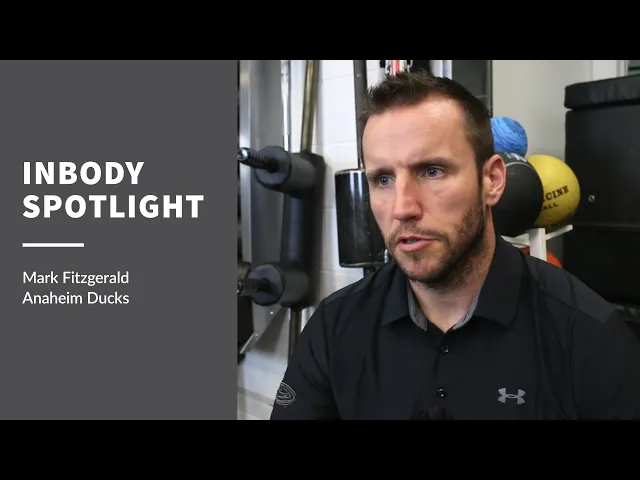
Mark Fitzgerald is the strength and conditioning coach for the Anaheim Ducks and the owner of Elite Training Systems, a high-performance training center catered to athletes. His philosophy is improving player performance through training, nutrition, and rest. The NHL season is physically demanding and hectic. Thus, Fitzgerald was looking for technology that could measure his player’s body composition in-house quickly and provide accurate, informative outputs. After referrals from trusted sources and self-experimentation, Fitzgerald found his solution in the InBody.
A tool to better utilize the Ducks’ time
Time constraints are an issue every NHL franchise must manage. The Ducks had the extra challenge of having the longest travel schedule in the league for the 2016-2017 season. During the course of 82 games and the 40,000+ travel miles, their players’ bodies began to break down.
“The travel and the schedule are very real issues. If you don’t take them into account in your nutrition profile, your rest, your work to rest on the ice, then you’re going to be putting your athletes in a pretty dangerous position.”
Fitzgerald created a comprehensive program to keep players healthy and ready to play. Players receive a daily report on their bodies’ readiness to perform. This allows Fitzgerald to track player condition and create open dialogue between player and coach.
Body composition is a vital metric of the assessment. The challenge was how to test the players consistently and accurately.
Fitzgerald had experience working with calipers and although they were quick and easy to use, he found the results were inconsistent.
The organization had access to a DEXA through a partnership with a local university. But to send players outside the facility, even just a few miles up the road, was difficult. When the team wasn’t traveling, the team was trying to accomplish a lot in the limited time available in the facility. The players had practice, film sessions, conditioning, etc. Although body composition testing was important, the time it was taking to test was taking away valuable time that could be put into other more productive activities. To get all 20 players tested with a 10-minute DEXA scan outside the facility was almost impossible to perform on a regular basis.
The idea of bringing a DEXA scanner in house was a logistical nightmare of its own.
What Fitzgerald needed was an in-house tool that was fast and convenient like calipers that also provided the accuracy and consistency of a DEXA.
“We use a lot of technology in Anaheim, and I’m careful with what technology we do bring in because I want it to be valuable. I want it to be something I can use for a long time because the value of all this testing data is to do it consecutively and to do it over a term and that’s where the value of what we’re trying to do here is seen.”
After reviewing and comparing other body composition devices on the market, Fitzgerald found what he needed in the InBody.
InBody results on par with more expensive methods
Fitzgerald was familiar with the other BIA devices on the market, but what separated InBody was who was also using the device.
“From day one, InBody did not have to sell me on it. It’s always been, “Here’s what we do. Here’s who’s using us. Talk to any of the teams that are using it. Talk to them and see what they say. To me that’s huge.”
Over 30 teams from the NHL, NBA, NFL, and MLB were already using InBody as well as the top names in strength and conditioning.
Todd Durkin, two-time Fitness Trainer of the Year and a personal colleague, was receiving exceptional results from using it at his facility. His satisfaction with InBody convinced Fitzgerald to give it a try.
Fitzgerald tested the InBody on himself once a week, same time everyday, in the same fasted state to check consistency.
After only two tests, he began seeing consistency in the testing results. A few more tests later, Fitzgerald began realizing the multitude of applications he could use with the outputs from the InBody. The more Fitzgerald tested, the more satisfied he became with the InBody. Next, he took the results to the Ducks’ university partner.
What the university told him blew him away.
“The university that we work with was able to validate, in some studies that they did, that it’s a valuable tool. When the university compared it to some of the other more expensive methods, the Bod Pod and the DEXA, they said it was right along with them.”
After trusted recommendations, self experimentation, and validation from a top university, InBody became an easy choice.
Getting viable information in under 1 minute
The ease of testing and the quality of information of the InBody 770 became a game changer. In 60 seconds, the InBody 770 gave Fitzgerald and his team accurate measurements of fat mass, skeletal muscle mass, and body water in each segment of the body.
Fitzgerald is now able to test his players on a regular basis in-house and collect vital data to tailor his training for his players needs.
All of the outputs from the InBody Test are provided on the InBody result sheet, which Fitzgerald uses to open dialogue with athletes on areas to focus on. At the highest level of professionals sports, open dialogue between coach and athlete is paramount. Professional athletes want to understand what they are doing. For Fitzgerald, the result sheet is essential in the education process. The InBody provides outputs that Fitzgerald can tie to his diet plans and workout plans.
Two areas of focuses are on nutrition and conditioning. His goal for all his players is to maintain a balanced, strong body so that they can stay on the ice.
Fitzgerald uses lean body mass to set targets for each of his players to maintain during the season. As the number increases or decreases, he can relate it back to what they are doing for nutrition.
“If you eat more higher sources of protein, it’s going to keep lean muscle mass on, you’re not as susceptible to soft tissue injuries and you keep that lean muscle. When one leads to the next and they’re intermingled, it brings more relevance to what I’m saying. It’s full circle.”
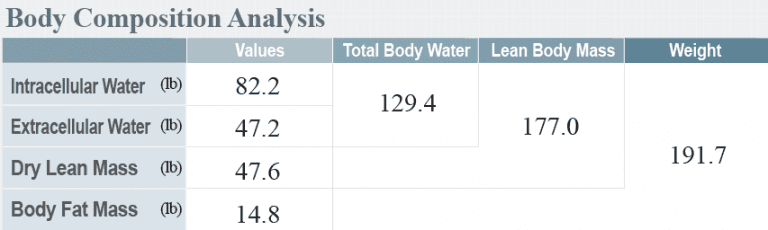
This helps reinforces the importance of diet and supplementation.
Fitzgerald uses the Segmental Lean Analysis section on the InBody result sheet as a guide to help the athlete better understand their body. Most hockey players are asymmetrical because they usually shoot a hockey puck off their dominant leg, working one side of the body significantly more than the other. A hockey player might not feel like they are physically unbalanced, especially if they are performing well. But an asymmetrical body can be vulnerable to injuries.
“Looking at the segmental analysis you’re able to tell them that’s why that happens. That single leg and single arm work I have you do – that’s why I have you do that work. We want to be able to balance those two things out. It’s never going to be perfectly balanced but we try to keep them a little more balanced than they are. Again, it opens the door for conversations.”
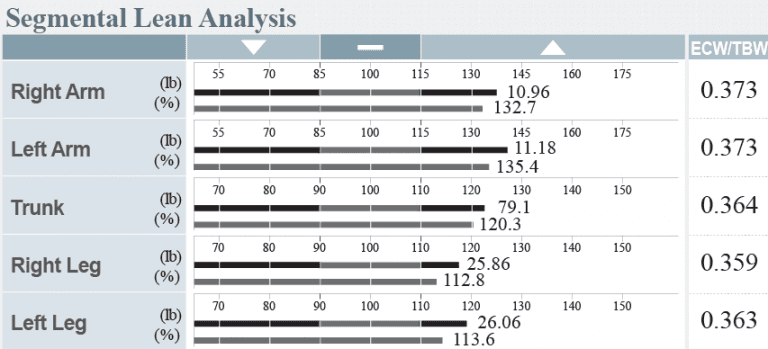
The InBody result sheet makes that easy to understand.
Correlation InBody outputs to athlete’s performance
Fitzgerald feels his value is in taking all the data, make sense of it for the players, and creating personalized plans. At the Duck’s training facility, they can take an athlete’s force plate number and see an athlete’s force production during a workout. He can then take the outputs of the InBody 770 provides to make correlations.
If an athlete has increased their force production by 5% over the last four weeks, Fitzgerald can compare those results to the InBody output. The InBody can show that after the addition of quality protein in the diet lean body mass increased. Or the addition of a single leg workout routine has lead to better balance between the right and left leg.
Fitzgerald can show his players with data that their efforts in nutrition and conditioning has directly lead to an increase in performance. That creates understanding for the players and validation for him and his programs.
“If you can find a way to help the athlete make sense of why they’re doing what they’re doing and how it benefits them, you’re ahead of the game. InBody allows me another tool to do that. It helps that [the Result Sheet is] tangible and it’s something they can hold onto.”
Using the InBody result sheet to create that connection between nutrition, training and improvements has led to buy-in from the players. Since implementing the InBody as a component of the program, the Anaheim Ducks have seen a reduction in injuries compared to years prior.
Athletes seeing the difference themselves
When Fitzgerald entered the franchise, his goal was to improve player health by creating a program that would encompass player strength and conditioning, nutrition, and rest. With the InBody, not only was Fitzgerald able to test his players quickly and accurately, but he also was able to use the InBody result sheet to create buy-in from his players.
“With the InBody print out, it open dialogue with the athlete, “Hey, what does this mean? Am I trending in the right way? How can I improve?” When you open those conversations with your athletes, that’s why I’m here. That’s why you coach.”
After adding InBody to his program, Fitzgerald has been able to take everything he is doing and bring it full circle. Players understand better why Fitzgerald has them train and eat a certain way because the InBody result sheet provides them objective proof. They buy in and are more committed to the program. After committing fully to the program, the players feel stronger, perform better, and stay on the ice.
“How many guys on our team played every game? I think we had quite a few compared to the last few years. How many guys that had injury issues in the past don’t have them anymore? We’ve made an intervention and changed what they’re doing and guys are happy to be in here every morning and happy to be part of what we’re doing.”
Looking for healthcare data to improve decision making to promote better patient outcomes? We can help. Contact Us